
Envision landing on a product page that seems to be designed only for you, showcasing the very features that matter to you, resonating with your values, and answering even the questions you never knew you had. Sounds intriguing, right? That’s the power of personalization. In today’s overpopulated digital marketplace, such things are not luxuries anymore.
Instead, they are expected. As consumer expectations become more specific, marketers increasingly need to create experiences that address needs at the individual level. New research says up to 47% and 76% of online shoppers expect personalized interactions with brands. Quite simply, organizations that fulfill this expectation reap sizable rewards. In fact studies show that personalization has led to an increase in revenue of more than 10%.
The product page is usually the last stop before a customer adds an item to their cart, where the actual decision is made. However, many brands use the same product descriptions for just anyone, which appears rather distasteful to shoppers who have expressed preferences or made purchases in the past. Imagine a page updating its content depending on whether the shopper was sustainability-minded (for instance, showing eco-friendly features) or recommending products that a customer may want to repurchase. These changes assist the customers in making a purchase, as they are being directed where to look and what to focus on.
In a world of limited attention and many choices, personalization offers marketers a huge advantage. And, if applied to a core subject such as product descriptions, it can be the difference between a bounce and a buy..
1. Why Generic Product Descriptions Fall Flat
If you’ve ever been in e-commerce, you know that product descriptions are not just filler content; they are the actual section for conversion by turning interest into intent. Yet brands treat them like some sort of a formality more often than not, as they rely on the same description for every visitor regardless of who they are and what they care about.
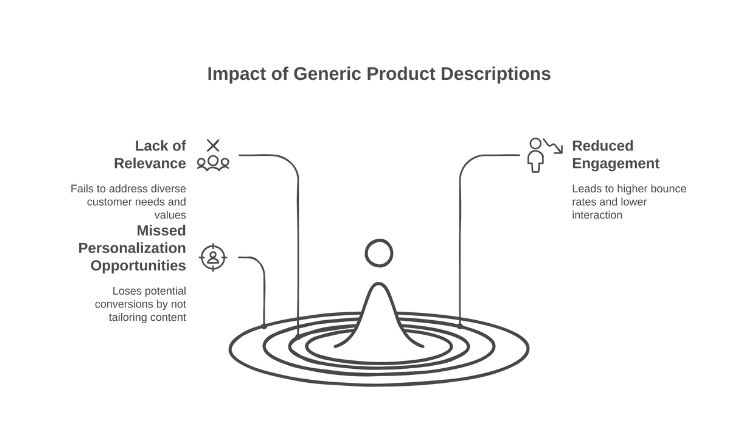
Today, more than ever, online shoppers do not ‘just browse’; they skim and compare swiftly while demanding information in hyper-personalized speech. A potential customer will leave your website after a few seconds if your product description does not prove its relevance.
Let’s break down why these generic descriptions are falling short:
i. Relevance
The core issue is that generic descriptions lack context. They assume that every shopper comes in with the same goals, values, and buying triggers, which we know isn’t true. Someone may be shopping for a gift; another may be back for a repeat purchase; and someone else may be browsing with very strong value judgments, only to purchase vegan or eco-friendly products.
Just imagine a consumer who has been searching for sustainable home wares, and they find themselves looking at a bamboo cutting board. The product is sustainably sourced, but the product description focuses instead on durability and design, with no mention of sustainability. That is an opportunity lost! You had the right product for the right customer, but unfortunately, the message failed to connect. That is what personalization solves. It helps bring the right benefits to the right shopper at the right time.
The likelihood of a person taking some action regarding a specific product increases considerably when he feels that such product was meant for him or at least advertised specifically for him.
ii. Engagement
Another disadvantage of generic descriptions is that they ruin actual user experience, and engagement dies. We have seen it repeated over and over again in the data: generic pages have higher bounce rates and lower session duration. The issue is there is nothing that hooks the visitors. There is no reason for them to scroll or read more or explore.
For instance, consider a customer who has previously purchased a camera. And now they’re browsing tripods. Rather than being presented with a description that points out compatibility with the model they already own, they are instead reading a spec-based description that is the same as what first time visitors are given. There is no reference to how it enhances their gear, there is no recognition of their previous purchase, just the product details. It’s forgettable.
On the other hand, personalization reduces the bounce rate by 45 percent. So when 76 percent of consumers say they experience some frustration when brands fail to offer personalization, it would be reasonable to conclude that if you are not personalizing your product content, you are not simply losing conversions but people.
In a nutshell, personalization is no longer an optional extra; It’s the difference between a product that sells and a product that sits.
2. What Actually Drives Conversions?
After recognizing the shortcoming of generic descriptions, one would naturally want to ask what it takes to create descriptions that really sell. Because, personalization goes beyond just dropping the shoppers’ names and recommending them “for you” banners. It is the understanding of what seems to matter to various customers and then developing product content around that understanding.
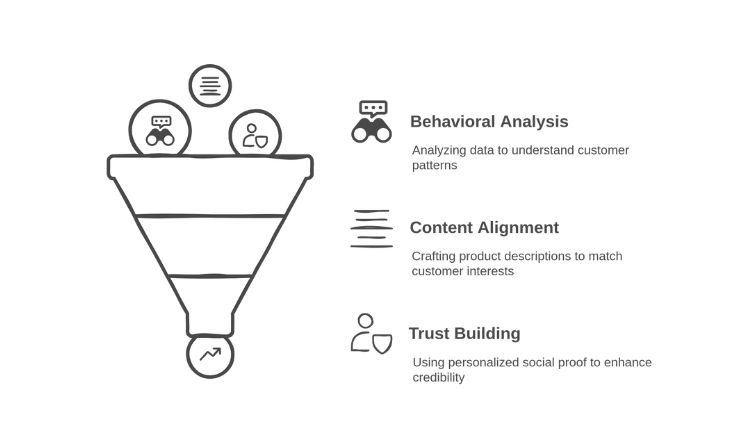
In its essence, high-converting product personalization begins with data. And not just any data, but the one that discusses intents, choices, and patterns. When you begin integrating behavioral cues into visitors’ data using data based on their prior searches or purchase behavior together with other demographic and self-reported data then you start to build a profile that’s actually useful. That’s when product descriptions can cease being simply blocks of text and begin to behave like personal sales pitches.
i. Alignment
This is where the magic happens: when the benefits highlighted in the description correspond directly to the customer’s interests. . For instance, if someone is shopping for running shoes after searching for “marathon gear” doesn’t need a description about fashion. They need to hear about long-distance support, breathability, and cushioning that lasts for 26 miles.
Additionally, it is not only important to list features. It is all about choosing and defining which specific characteristics would be suitable for a particular individual. And when that is done successfully, the goal is achieved. Companies that adapt their content to a person’s specific behavior experience up to 20% increase in conversions. Also, language matters. You have to adjust your tone to each particular shopper. A young, trendy buyer would probably respond to bold, energetic copy. A parent buying for their child? They’re going to lean toward reassurance and reliability. This kind of tone matching is likely to increase trust and action when it is subtle and authentic.
ii. Trust
People want to hear from those who are similar to them. That’s why social proof is so powerful – and it becomes instantly more effective when it’s personalized. Instead of a wall of generic five-star reviews, imagine a shopper seeing testimonials from other people in his city, age group, or who bought the same size or variation. This relevance builds instant credibility. Interestingly, 72% of consumers believe that they trust businesses that display positive reviews, and when such reviews are perceived to be genuine, the effect doubles. Customers who feel understood and catered not only convert faster but stay with the business. Personalized experiences based on the preference of individuals lead to 33% higher lifetime value.
So, what it really comes down to is that this personalization is very deliberate and data-driven to more humanize it. It doesn’t simply optimize product pages; it actually changes the very experience for the shopper. And the customer is much more likely to click on that add-to-cart button when they feel that a purchase experience is personalized, helpful, and credible.
3. The Strategy Behind the Science
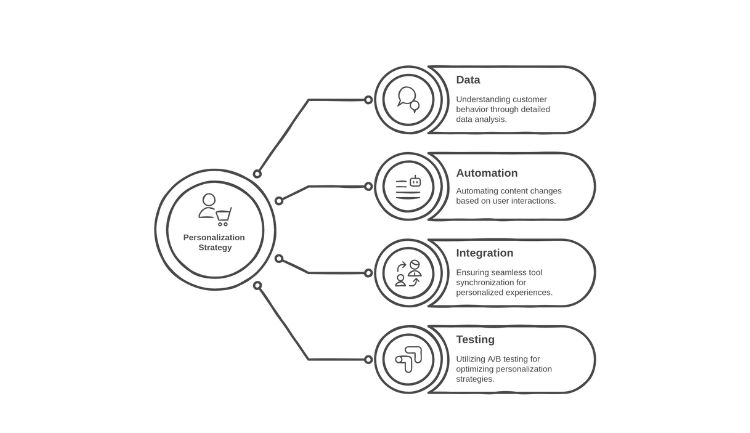
The truth is, personalization does not ‘just happen’ because you give a description that sounds very nice. The real magic lies in how you build the system that fuels it. Excellent brands think of personalized product content as some engine: just as any engine needs fuel (that means data), a smart design (AI), and regular tuning (testing) to run those engines for their full effect.
i. Data
The first step in this process is to know the customer. But not just in the literal sense, such as, “she’s 35 years old and lives in Chicago”. You need context of what they have clicked on, what they have dwelled on, what they have left on cart, what section they frequently visit. Every click represents a narrative and that narrative is your script of the product description.
Consider a shopper who visits vegan skincare products multiple times but always goes through the ingredient list can find a description on a product page leading with something like, “Formulated with 100% plant-based ingredients and absolutely no synthetics” — informative, but more so, feels like they were made for them. Now, when you write with intent based on the customer, not just the product, action is created.
ii. Automation
Of course, no one rewrites hundreds of descriptions manually every time a new visitor comes to your site. This is where web personalization platforms really help you out. With the correct setup, the automation will do all the hard work—changing descriptions depending on the user’s behavior, preferences, or occasion, in real time.
Assuming that two people, one from Minnesota and one from Los Angeles, land on the same page for a winter jacket. The first visitor views a description that emphasizes insulation and warmth: “Built to keep you cozy through sub-zero temps.” The latter sees something more versatile: “Perfect for layering on cool nights or chilly commutes.” It’s the same product, but it feels completely tailored. That’s the magic of dynamic content.
This is also backed by figures. Utilizing behavioral data for personalization, brands have watched conversion rates soar by as much as 20%. Add artificial intelligence to the mix, and some projections predict a 30% lift in revenue for retailers by 2030.
iii. Integration
Personalization functions well only when all your tools work in sync with each other. It means that your CRM, CMS, CDP and personalization engine should exchange information so that everything is in harmony. Otherwise, it could leave the customer feeling that the experience was disjointed. When said systems integrate well, everything can be optimized to show the right content at the right time and place in achieving a smooth and personal journey.
iv. Testing
Last but not the least, the testing phase is an integral part of any strategy. Even the smartest AI needs feedback. That is where the A/B testing comes into play — it provides you with real-life experience about what works and what does not.
For example, imagine you compare two different texts of a product description for a new yoga mat. One leads with emotion, “Your new sanctuary, one breath at a time.” The other leads with details, such as “Constructed with 6mm cushion and non-slip grip”. The first one may be more suitable for the occasional shopper, while the second one may be more effective for the repeat customer. Such information enables you to tailor it even further the next time.
4. Measuring the Impact
One way to prove that this personalization does work is with data. In the business of e-commerce, the most powerful thing is data. If you invest your time in personalized product descriptions, you should check whether they are still engaging or even effective, this means moving beyond your instinct and very closely watching the right numbers.
a. The Metrics That Matter
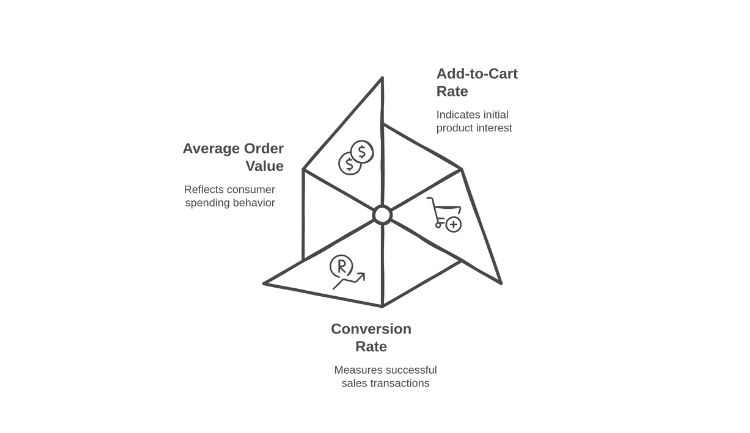
Let’s start with the basics: first, your add-to-cart rate would be an indicator that a description is working well; if people read about a product and are quickly led to click the “Add to Cart” button, that’s your green light. Then there’s the conversion rate, which tells us how many of those clicks turn into sales. Don’t forget about average order value (AOV). When personalization is done correctly, consumers are inclined to add one more item to their cart or select a variation that is more suitable for them.
Envision this, you are running an A/B test: one group is presented with the generic product description, while the description for the other group is customized for their browsing habits. The personalized version leads to 15% more adds to cart, a lift in conversions by 10%, and an increase in AOV by 20%. This is not just a nice-to-have; this is growth- evidenced by the numbers.
b. Tools That Track and Tell the Story
To obtain such insights, it is necessary to rely on the analytics solutions. Almost all the current online shopping solutions allow for adding personalization and monitoring its effectiveness against standard solutions. That’s where heat maps, scroll depth and behavioral tracking of the site come into the picture to show where the users linger, where they click and what prompts them to act.
Thus, web personalization platforms shine here. Not only do they facilitate the delivery of relevant content to a specific audience, but it also measures the effectiveness of delivering personalized content in real-time — a challenging task that does not require much effort from your team to map content, behaviour, and outcomes.
And here is the most thrilling factor: research has proven that personalized recommendations yield a 369 percent increase in AOV when compared to generic recommendations. When descriptions are crafted to speak to what someone values or needs, they don’t just interact, they often buy more.
c. Turning Insights Into Action
Measurement is not only about self-praise. It is about figuring out what gets the desired results and amplifying it. Perhaps you might have observed that customers are more receptive to benefit copy that ties into lifestyles across different product categories. Or you may find that, for instance, first-time customers are more responding to social proofing, whereas second-time consumers are more positively affected by features. These are golden insights that you can make some foundations on.
Finally, when data is not viewed as an add-on but a compass, you get the ability to make it better, enhance it and always get the desired outcome.
Conclusion:
Tailored product descriptions are among the most efficient triggers for adding items to shopping carts and conversion eventually. By gathering data appropriately to speak to what matters most to each customer, brands can put together experiences that can lead to conversion.It becomes clear that in the future, including regards to artificial intelligence and machine learning, personalization will become even more refined as well as significantly more scalable. At its core, however, the goal overseas remains the same: understanding your customer and making their experience feel timely and meaningful.
In future scenarios, personalization would go beyond the product page itself. It would cover all touchpoints. The succeeding brands would be the ones that put clarity, connection, and customer trust first solely through a personalized message.
Author’s Bio:
Vidhatanand is the Founder and CEO of Fragmatic, a web personalization platform for B2B businesses. He specializes in advancing AI-driven personalization and is passionate about creating technologies that help businesses deliver meaningful digital experiences.